Disclosure & A Larger World · Grounding Guide
What Is Ontological Shock?
Ontological shock is the disorientation that can occur when an experience, discovery, or possibility disrupts the framework through which a person understands reality.
The old map no longer feels sufficient, but a new map has not yet formed. Questions about identity, meaning, authority, humanity, spirituality, science, safety, and the nature of the world can arrive all at once. The challenge is not to force immediate certainty, but to remain grounded while understanding catches up.
Ontological shock is a descriptive idea, not a formal diagnosis and not proof that any particular extraordinary explanation is true. Persistent or severe distress deserves qualified medical or mental-health support.
Changed
A framework is disrupted, the person stabilizes attention and daily life, and a more spacious understanding develops without demanding premature conclusions.
A Working Definition
Ontological shock begins when the underlying map of reality is disrupted
Every person lives within an ontology: an often-unspoken understanding of what exists, what is possible, what counts as knowledge, who can be trusted, what human beings are, and where meaning comes from.
Most daily decisions rely on this framework without requiring it to be examined. Ontological shock occurs when something places unusual pressure on the framework itself. The disruption may come from a personal experience, scientific discovery, technological development, cultural disclosure, spiritual crisis, loss, or information that cannot easily be reconciled with what was previously assumed.
The distress comes not only from new information, but from the possibility that the categories used to interpret information may also need to change.
What It Does Not Establish
Disorientation does not prove the interpretation attached to it
A powerful reaction can be psychologically and spiritually meaningful while the cause, explanation, and factual implications remain uncertain.
Not a formal diagnosis
The phrase describes worldview disruption. It should not replace assessment by qualified professionals when distress, sleep loss, anxiety, depression, or impaired functioning becomes significant.
Not proof of contact or disclosure
Feeling shocked, transformed, frightened, or awakened does not independently verify a claimed entity, event, message, program, or explanation.
Not a failure of intelligence
Even thoughtful and well-informed people can become disoriented when foundational assumptions are challenged faster than they can be integrated.
What Can Trigger It?
The disruption can be personal, collective, scientific, spiritual, or technological
The trigger matters, but the deeper pattern is similar: a previously reliable worldview no longer explains enough.
An event does not fit existing categories
A vivid anomalous, spiritual, near-death, dreamlike, perceptual, or unexplained experience may challenge assumptions about mind, reality, identity, or consciousness.
Institutions acknowledge previously excluded possibilities
Documents, testimony, scientific findings, official statements, or credible investigations may alter what people believe can be discussed seriously.
A discovery reshapes the human place in reality
New knowledge about life, consciousness, intelligence, technology, space, time, or the universe can unsettle inherited philosophical and religious assumptions.
A former source of meaning no longer holds
Bereavement, illness, betrayal, disaster, or major life change can expose how much identity and certainty depended upon structures that have disappeared.
Four Dimensions
Ontological shock affects more than belief
It can alter thought, emotion, relationship, identity, and the felt meaning of ordinary life at the same time.
The old explanation no longer organizes experience
A person may repeatedly revisit evidence, search for a complete theory, struggle with uncertainty, or feel unable to place the new information within existing knowledge.
Wonder and fear may arrive together
Awe, grief, excitement, anger, relief, dread, hope, betrayal, and vulnerability can coexist rather than forming one clear emotional response.
Shared assumptions may no longer feel shared
People may fear ridicule, become isolated, argue with loved ones, seek only confirming communities, or struggle to communicate an experience that feels difficult to translate.
Identity and meaning may need to be reconsidered
Questions arise about what it means to be human, what can be known, whether inherited authorities remain trustworthy, and what responsibilities follow from a larger reality.
How It May Feel
The response can range from quiet uncertainty to significant distress
These experiences are possible reactions, not a diagnostic checklist. Their meaning depends upon context, duration, intensity, health, and daily functioning.
Persistent preoccupation
The mind may return repeatedly to the same question, evidence, event, or explanation because it feels too important to set aside.
A changed sense of reality
Familiar places, institutions, beliefs, or routines may feel different because the interpretive framework beneath them has shifted.
Urgency to understand
The person may consume information rapidly, feel pressure to reach certainty, or believe that immediate decisions are required.
Difficulty communicating
Language may feel inadequate, and the person may worry that others will dismiss, misunderstand, pathologize, or exploit what they are trying to describe.
A Possible Integration Path
Disruption does not have to become collapse
The process is rarely linear, but four movements can help the person understand what integration requires.
The previous map stops explaining enough
Contradiction becomes visible. Familiar assumptions may feel fragile, incomplete, or impossible to recover in their former form.
Daily life and the nervous system need support
Sleep, food, movement, routine, trusted contact, reduced information overload, and professional care when needed help restore capacity.
Possible explanations are examined without forced certainty
Observation is separated from inference, evidence from meaning, and what is known from what remains possible or unknown.
A wider worldview develops without erasing ordinary life
The experience becomes part of identity and understanding while relationships, responsibilities, humility, and practical judgment remain intact.
Ground Before Concluding
Stability is not denial
Grounding does not mean dismissing the experience or returning automatically to the old worldview. It means restoring enough physical, emotional, and relational steadiness to examine what happened without being driven entirely by urgency.
Maintain sleep and meals as consistently as possible. Continue ordinary responsibilities where safe. Limit repeated exposure to emotionally activating material. Spend time with trustworthy people who can listen without escalating certainty or ridicule.
Postpone major financial, relational, medical, legal, or public decisions when the experience is acute. A worldview may need to change, but not every part of life needs to be dismantled at once.
Seven Grounding Practices
Create space between disruption and interpretation
These practices are not substitutes for professional care. They are simple ways to support perspective while determining what further help is needed.
Reduce immediate pressure
Give the mind permission not to decide what everything means today. Delay irreversible choices while intensity is high.
Separate observation from interpretation
Write what was directly experienced, what was reported by others, what was inferred later, and what remains unknown.
Limit information flooding
Choose defined periods for reading or research instead of consuming an uninterrupted stream of alarming or confirming material.
Keep contact with ordinary time
Sleep, meals, movement, work, household tasks, nature, and familiar relationships provide continuity while meaning reorganizes.
Resist isolation
Speak with trusted people who can tolerate uncertainty and help notice changes in functioning, behavior, or escalating distress.
Seek corroboration and alternatives
Examine source quality, incentives, provenance, missing information, competing explanations, and what evidence would change the conclusion.
Use qualified help when distress is significant
Medical or mental-health professionals can help with sleep disruption, anxiety, depression, trauma reactions, altered perception, or impaired functioning without requiring a final judgment about every belief.
A Three-Column Discernment Tool
Separate what is known, inferred, and unknown
This simple structure helps prevent urgency or emotion from collapsing different levels of certainty into one conclusion.
What can be directly supported?
Record observations, documents, measurements, statements, dates, sources, and experiences as precisely as possible.
EvidenceWhat explanation is being proposed?
Name the interpretation, assumptions supporting it, alternative explanations, and where uncertainty enters.
InterpretationWhat has not yet been established?
Preserve uncertainty honestly. An unanswered question is not an empty space that must be filled by the most dramatic possibility.
HumilityWhen to Seek Professional Support
Severe or persistent disruption deserves care
Qualified support is especially important when sleep is significantly reduced, anxiety or depression is intense, daily functioning declines, relationships or finances are being damaged, substance use is increasing, perception feels persistently altered, or the person feels unable to slow escalating thoughts and research.
Urgent professional help is warranted when there is danger of self-harm, harm to another person, inability to care for basic needs, severe confusion, or behavior driven by commands or beliefs that create immediate risk.
A clinician can address distress and safety without demanding that every spiritual, philosophical, anomalous, or disclosure-related question be resolved first.
Collective Ontological Shock
A society can also lose confidence in its map of reality
Large-scale disclosure or discovery would not affect everyone in the same way. Responses would differ across religion, science, politics, culture, generation, and personal history.
Institutions would be tested
Public trust would depend upon transparent communication, acknowledgement of uncertainty, correction of error, and resistance to manipulation.
Communities would interpret differently
One event could be understood as scientific discovery, spiritual confirmation, political crisis, cultural transformation, or psychological threat.
Information quality would matter
Rumor, fabrication, genuine evidence, propaganda, misidentification, and emotionally compelling speculation could circulate together.
Meaning would need time
Public understanding would develop unevenly. Responsible leadership would make room for uncertainty, grief, wonder, skepticism, and gradual integration.
The Trilogy’s Response
Light and fire prepare the reader for a changed horizon
Ontological shock is not approached only as an information problem. It is also a test of attention, dignity, relationship, conscience, and the ability to remain whole.
Book One · Light
Inner light supports truthful seeing, distinguishes illumination from spectacle, and helps the reader recognize what must remain morally visible.
Book Two · Fire
The tended fire supports warmth, routine, integrity, boundaries, relationship, and return when uncertainty becomes destabilizing.
Book Three · Horizon
The larger world is approached with discernment, dignity, cosmic humility, contact without worship, and openness without collapse.
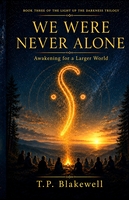
The Book Behind the Reflection
We Were Never Alone asks how humanity can remain whole when the horizon changes
Book Three of the Light Up The Darkness Trilogy is a contemplative work of serious inquiry about disclosure, contact, ontological shock, cosmic humility, human dignity, and awakening responsibly.
- Extraordinary questions without forced certainty.
- Disclosure approached without spectacle.
- Contact without worship or fear.
- Cosmic humility without human self-erasure.
- A larger world met with dignity and moral seriousness.
Continue Reading
Four companion essays extend the grounding framework
Disclosure Without Spectacle
Explore why excitement and fear are inadequate substitutes for transparent evidence, preparation, and moral seriousness.
DignityContact Without Worship
Consider how humanity can remain open to encounter without surrendering conscience, consent, boundaries, or agency.
Trilogy ArcFrom Light to Fire to a Larger World
See how inner illumination and soul-tending create the foundation beneath responsible openness to the unknown.
Article CollectionDisclosure & A Larger World
Follow the full collection on discernment, contact, dignity, cosmic humility, and awakening beneath a larger sky.
Let Understanding Catch Up
A changed worldview does not need to become an immediate collapse—or an immediate certainty.
Read the opening pages of Book Three, explore the Disclosure & A Larger World collection, or join Letters of Remembrance for essays, reader resources, and publishing updates.
Frequently Asked Questions
Questions about ontological shock
What is ontological shock?
Is ontological shock a mental-health diagnosis?
Does ontological shock prove that an extraordinary interpretation is true?
How can someone ground themselves during ontological shock?
How does ontological shock connect to We Were Never Alone?
