Disclosure & A Larger World · Foundational Essay
Contact Without Worship
A larger intelligence—real, possible, imagined, spiritual, technological, or not yet understood—should never require the surrender of human dignity, conscience, or moral agency.
Contact without worship is the discipline of remaining open to encounter while refusing fear, projection, obedience, self-erasure, and certainty that has not been earned. It asks whether humanity can meet the unknown with humility without kneeling before it.
This essay does not claim that any specific contact event, entity, government program, spiritual message, or extraordinary experience has been verified. It offers a framework for dignity and discernment in the face of extraordinary possibilities and claims.
Remain open enough to encounter, discerning enough to evaluate, and whole enough to retain conscience, boundaries, dignity, and choice.
What the Phrase Means
Encounter does not require submission
“Contact” can describe several kinds of encounter: an intellectual encounter with the possibility of non-human intelligence, a cultural encounter with a universe larger than inherited assumptions, a spiritual or psychological experience interpreted as contact, or a future direct encounter that can be independently examined.
“Worship,” in this context, does not mean reverence, wonder, gratitude, or respectful attention. It means surrendering judgment, agency, conscience, or moral responsibility to a being, message, institution, technology, or claim because it appears more powerful, advanced, mysterious, or spiritually impressive.
Contact without worship therefore holds two commitments together: remain open to what may be real, and refuse to abandon the human capacity to evaluate, choose, question, and act responsibly.
Necessary Distinctions
Awe is not obedience, and humility is not self-erasure
Extraordinary possibilities can produce intense emotion. Clear distinctions protect the reader from turning intensity into authority.
Awe is not proof
An experience can feel profound, beautiful, frightening, or sacred without establishing a factual explanation for what occurred.
Humility is not inferiority
Humanity may not be central, alone, or the most advanced intelligence in existence. None of those possibilities requires treating human life as worthless.
Openness is not surrender
A person can consider unfamiliar evidence or interpretation while retaining boundaries, skepticism, agency, and the right to say no.
Why the Risk of Worship Appears
Power differences invite projection
Human beings have repeatedly mistaken greater power, knowledge, spectacle, or unfamiliarity for moral perfection. A contact framework must anticipate that tendency rather than assuming it will disappear.
Capability can be mistaken for goodness
A more advanced technology or intelligence may possess greater capability without possessing greater compassion, justice, or respect for autonomy.
Longing can fill uncertainty with meaning
People may project hopes for rescue, judgment, transcendence, belonging, healing, or cosmic purpose onto what remains unknown.
Intensity can overwhelm evaluation
Extraordinary imagery, emotion, technology, or experience may interrupt careful thought and make immediate interpretation feel necessary.
Responsibility can be handed away
A message may be treated as unquestionable because it is believed to come from a superior source, allowing the receiver to avoid moral accountability.
Four Commitments
Contact without worship preserves the conditions of a dignified encounter
These commitments apply whether the “contact” is philosophical, cultural, spiritual, technological, informational, or potentially direct.
Remain a moral subject, not an object
Do not accept the premise that greater power eliminates the worth, consent, rights, or moral standing of the less powerful.
Evaluate claims and conduct separately
Ask what is known, what is inferred, what can be corroborated, and whether the claimed source behaves in ways consistent with respect and truthfulness.
Expect mutual recognition
A dignified encounter should not require one side to surrender all boundaries, questions, privacy, autonomy, or capacity to refuse.
Retain ownership of human choices
No alleged message removes the responsibility to examine consequences, protect others, seek evidence, and answer for one’s own conduct.
A Spectrum of “Contact”
Use language precise enough for the kind of encounter being described
Different experiences require different standards of interpretation. Treating them as identical creates confusion and can encourage unsupported conclusions.
Contact as an idea
Considering that non-human intelligence may exist is an intellectual encounter with possibility. It does not establish that direct contact has occurred.
Contact as evidence
Data, testimony, imagery, records, or physical observations should be assessed for provenance, corroboration, alternatives, limitations, and manipulation.
Contact as experience
A personal experience may carry deep meaning while its cause remains uncertain. Meaning and verification are related questions, not the same question.
Contact as direct encounter
A claimed direct encounter would require exceptional care: documentation, independent examination where possible, consent, boundaries, and protection against coercion.
A Grounded Response
Six steps before belief, obedience, or public declaration
The goal is not automatic dismissal. It is to create enough space for careful evaluation and responsible choice.
Reduce the pressure to decide immediately
Strong emotion and urgency can narrow thought. Delay irreversible decisions until the experience or claim can be considered more fully.
Separate observation from interpretation
Write what was directly perceived, what was later inferred, what was learned from others, and what remains unknown.
Seek independent corroboration
Examine source history, evidence quality, alternative explanations, incentives, inconsistencies, and whether claims can be tested.
Do not surrender consent or boundaries
No extraordinary claim should automatically override bodily autonomy, privacy, relationships, finances, safety, or moral judgment.
Judge conduct, not claimed status
Ask whether the message or source respects consent, truth, dignity, non-coercion, accountability, and the well-being of others.
Resist isolation
Maintain contact with trusted people and qualified support. Isolation makes manipulation, escalating certainty, and loss of perspective more difficult to recognize.
Coercion Should Not Be Spiritualized
Extraordinary claims do not receive an exemption from ordinary safeguards
Be especially cautious when a message, leader, group, alleged entity, or interpretation demands secrecy, isolation, obedience, money, sexual access, dangerous conduct, self-harm, harm to others, abandonment of medical care, or separation from trusted relationships.
Other warning signs include claims that the recipient is uniquely chosen and therefore beyond criticism, that questioning proves spiritual failure, that predictions must be repeatedly reinterpreted after they fail, or that all outside evidence is part of a hostile deception.
Respectful encounter does not require coercion. A source worthy of trust should not need to destroy the faculties by which trust is responsibly formed.
Respect Without Submission
Contact can be approached with reverence and boundaries at the same time
The refusal to worship is not hostility. It is the preservation of conditions under which genuine relationship could exist.
Respect difference
Do not assume unfamiliar intelligence must think, communicate, value, or perceive exactly as humans do.
Protect consent
Difference in capability does not erase the need for permission, boundaries, transparency, and the ability to refuse.
Allow questions
A relationship that cannot survive honest inquiry is not made more trustworthy by being called advanced, sacred, or cosmic.
Preserve accountability
All participants remain responsible for conduct and consequences. Claimed superiority should not place anyone beyond ethical examination.
Beyond the Two Reflexes
Contact does not have to become salvation or threat
Public imagination often places non-human intelligence into one of two roles: rescuer or invader. Both responses can erase complexity. Worship imagines perfection. Fear imagines absolute hostility. Each turns the unknown into a screen for human expectation.
Contact without worship allows for a wider range of possibilities. Intelligence may be benevolent, indifferent, mixed, limited, unfamiliar, deceptive, cooperative, or ethically diverse. Humanity may encounter information before relationship, ambiguity before clarity, and long periods in which certainty remains unavailable.
The mature response is not emotional emptiness. It is the capacity to feel wonder, concern, hope, and uncertainty without allowing any single reaction to become unquestionable authority.
Human Dignity in a Larger Universe
Worth does not depend on being alone, central, or superior
A larger universe may challenge human self-importance without requiring human self-contempt.
Dignity is not dominance
Human worth need not depend upon being the most powerful, knowledgeable, ancient, or technologically capable intelligence.
Humility can strengthen responsibility
Recognizing humanity as part of a larger reality can deepen care for one another, the Earth, and the consequences of collective choices.
Agency remains meaningful
Even within a reality larger than imagined, human beings still choose how to treat one another, what to believe, what to protect, and what to become.
Why the First Two Books Matter
Contact without worship depends upon light and fire
Book Three’s principle is grounded in capacities developed across the complete trilogy.
See what is happening
Inner light supports clarity, conscience, truthfulness, and the ability to distinguish illumination from spectacle.
RememberRemain inwardly steady
The tended fire supports warmth, integrity, boundaries, relationship, discipline, and return when uncertainty becomes destabilizing.
TendMeet the unknown without kneeling
The grounded reader can remain open to a larger world while protecting dignity, discernment, consent, and moral agency.
Awaken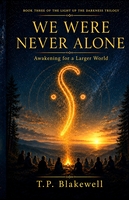
The Book Behind the Principle
We Were Never Alone asks how humanity can remain whole beneath a larger sky
Book Three of the Light Up The Darkness Trilogy is a contemplative work of serious inquiry about disclosure, contact, ontological shock, cosmic humility, human dignity, and responsible awakening.
- Contact without worship or fear.
- Discernment without reflexive dismissal.
- Cosmic humility without human self-erasure.
- Openness without abandonment of evidence or boundaries.
- A larger world approached with moral seriousness.
Continue Reading
Four companion essays deepen the larger-world framework
Disclosure Without Spectacle
Explore why excitement and fear are inadequate substitutes for understanding, preparation, and moral seriousness.
Worldview ChangeWhat Is Ontological Shock?
Understand the disorientation that can occur when inherited assumptions about reality no longer feel sufficient.
Trilogy ArcFrom Light to Fire to a Larger World
See how inner illumination and soul-tending create the foundation beneath responsible openness.
Article CollectionDisclosure & A Larger World
Follow the full collection on contact, discernment, dignity, cosmic humility, and awakening beneath a larger sky.
Remain Open. Remain Whole.
The unknown does not need to be worshiped in order to be taken seriously.
Read the opening pages of Book Three, explore the complete trilogy, or join Letters of Remembrance for essays, reader resources, and publishing updates.
Frequently Asked Questions
