Disclosure, Discernment & a Larger World
A Serious Inquiry Into What Humanity May Be Called to Become
This page explores the themes at the center of We Were Never Alone: Awakening for a Larger World by T.P. Blakewell — not as a summary of contested events, but as a philosophical and contemplative inquiry into what it means to hold extraordinary questions with seriousness, discernment, and dignity.
A note on sourcing: This page distinguishes between philosophical exploration, the author’s perspective, publicly reported events, and verified information. Contested claims are not presented as established facts. Readers are encouraged to apply their own discernment.
1. Disclosure Approached With Seriousness Rather Than Spectacle
The word “disclosure” has accumulated a great deal of noise. It appears in headlines, in congressional testimony, in social media, and in a vast ecosystem of speculation that ranges from careful journalism to outright fabrication. It is easy, in this environment, to dismiss the entire subject — or to embrace it uncritically.
This book and this page take a third position: that the questions raised by the possibility of non-human intelligence deserve to be held with the same seriousness we bring to any other significant question about the nature of reality and the human situation. Not with credulity. Not with reflexive dismissal. With discernment.
Seriousness, in this context, means: reading carefully, thinking slowly, distinguishing between what is known and what is claimed, and asking what the question requires of us — regardless of how it is ultimately answered.
2. Discernment Without Reflexive Denial or Uncritical Belief
Discernment is not skepticism and it is not belief. It is the capacity to hold a question open — to neither close it prematurely with denial nor fill it prematurely with certainty.
Reflexive denial says: this cannot be true, therefore I will not look. Uncritical belief says: this must be true, therefore I need not look carefully. Both are failures of discernment. Both protect us from the discomfort of genuine inquiry.
The practice of discernment asks something harder: to look carefully, to distinguish between sources, to hold uncertainty without anxiety, and to remain open to revision as new information becomes available. It is a practice, not a position. It requires ongoing attention rather than a single decision.
The book does not tell the reader what to believe about disclosure. It offers companionship in the practice of thinking carefully about it.
3. Contact Without Worship
One of the recurring patterns in accounts of contact — whether historical, religious, or contemporary — is the human tendency toward worship. To encounter something vastly different from oneself, something that exceeds one’s categories, is to feel the pull toward reverence, submission, or awe that collapses into deference.
The book argues for a different orientation: contact without worship. This does not mean contact without respect, or without wonder, or without appropriate humility. It means contact that does not require the abandonment of one’s own moral center, one’s own judgment, or one’s own dignity as a human being.
Whatever we may encounter — and the book makes no claims about what that might be — we encounter it as human beings, with all that entails. The question is whether we can remain ourselves in the encounter.
4. Recovery of Human Dignity
A recurring theme in disclosure discourse is the diminishment of the human. In some accounts, humanity is small, primitive, manipulated, or irrelevant in a cosmos populated by more advanced beings. This framing, whatever its source, tends to produce either despair or a compensatory grandiosity.
The book is interested in a different question: what does it mean to recover and maintain human dignity in the face of a larger world? Not the dignity of superiority — the claim that we are the most important beings in the universe — but the dignity of genuine selfhood: the capacity to think, to choose, to care, to be responsible for what we do with what we know.
Human dignity, in this sense, is not diminished by the existence of other forms of intelligence. It is, if anything, clarified by it.
5. Cosmic Humility
Cosmic humility is not self-abasement. It is the recognition that the universe is larger than our current frameworks can accommodate — and that this is not a threat but an invitation.
Every significant expansion of human understanding has required a revision of what we thought we knew. The recognition that the Earth is not the center of the solar system. The recognition that the solar system is not the center of the galaxy. The recognition that the galaxy is one of hundreds of billions. Each of these revisions required humility — the willingness to let go of a smaller picture in favor of a larger one.
The possibility that we are not alone in the universe is, in this sense, continuous with a long history of expanding horizons. Cosmic humility is the disposition that makes such expansion possible without producing collapse.
6. Ethical Preparation for a Larger World
If the questions raised by disclosure are serious — and this page proceeds on the assumption that they are — then they carry ethical weight. How we respond to the possibility of a larger world is not only an intellectual question. It is a moral one.
What kind of people do we want to be in relation to what we do not yet fully understand? What values do we want to bring to encounters that exceed our current categories? What do we owe to each other, and to whatever else may exist, as we navigate this moment?
The book does not answer these questions. It holds them open and asks the reader to sit with them seriously. Ethical preparation, in this sense, is less about having the right answers and more about cultivating the right quality of attention — the discernment, dignity, and humility that any genuine encounter will require.
7. We Were Never Alone — Available Now in Softcover
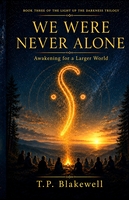
We Were Never Alone: Awakening for a Larger World is the third book in the Light Up The Darkness trilogy by T.P. Blakewell. The softcover edition is available now through IngramSpark.
Purchase through IngramSpark · Secure external checkout · Opens in a new tab
8. Read the Free Preview
The opening movement of We Were Never Alone is available to read free. No email required to read the preview on the preview page.
We Were Never Alone: Awakening for a Larger World
Read the opening pages free. No email required.
Read the Free Preview →9. Related Articles
10. Frequently Asked Questions
Does this book claim that UFOs or non-human intelligence are real?
No. The book does not make factual claims about the existence, nature, or intentions of non-human intelligence. It is a philosophical and contemplative work that takes the question seriously and explores what it requires of us — regardless of how it is ultimately answered. Readers are encouraged to apply their own discernment to the underlying factual questions.
Is this a book about UFOs?
Not primarily. It is a book about how to think, feel, and live in relation to questions that exceed our current frameworks. The possibility of non-human intelligence is the occasion for the inquiry, not its subject. The subject is human dignity, discernment, and ethical preparation for a larger world.
Does the book take a political position on government disclosure?
No. The book does not advocate for or against any government program, policy, or disclosure initiative. It is not a political work. It is a contemplative one.
Is this a religious or spiritual book?
It is a contemplative work of literary nonfiction. It draws on the language of awakening and moral seriousness without belonging to any specific religious tradition. It does not claim religious authority or require any particular belief.
How does this book relate to the rest of the trilogy?
Book One awakens the light within. Book Two teaches how to tend the sacred fire. Book Three opens the horizon toward a larger world. The three books form a complete arc, but each can be read independently. View the full trilogy →
Can I read a sample before purchasing?
Yes. Read the opening pages free here — no email required.
